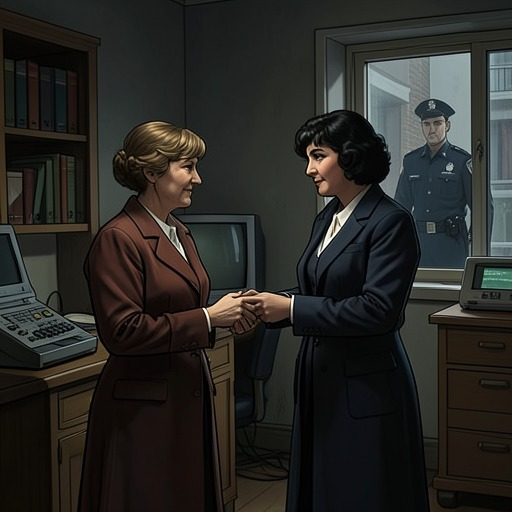
Grace Poe and Buddy Harris’s past romance
American RustGrace Poe and Bud Harris’s past romance is not a completed courtship so much as a possibility that keeps returning: Grace twice comes close to leaving Virgil Poe for Harris, remains attached to him after years of separation and other relationships, and eventually considers approaching him again. The pull between them is bound up with Grace’s constrained choices, her disillusionment with Virgil, and her effort to recover a sense of direction. The narrative makes room for hope, but does not confirm that the two reunite.
Origins and Circumstances
Grace’s adult life begins under pressure to follow a path chosen by others. At eighteen, after graduating high school, she comes home to find a new car and pay stubs waiting for her: her father has arranged for her to start at Penn Steel on Monday. She works a year on the rolling line, where she meets Virgil. She becomes pregnant and they marry. Grace wonders whether marriage was partly an escape from the mill, but the account gives no simple answer: she starts college while pregnant and continues with a baby in tow, nearly completing an associate degree before layoffs end that possibility.
The economic collapse of the Mid-Mon Valley narrows the options available to Grace and Virgil. After Virgil loses his job, the couple waits for the mills to reopen, but work remains scarce; Grace has a young child and cannot continue school. Their trailer goes into foreclosure. Residents’ protests lead a judge to halt foreclosures, and the family manages to keep the home while relying on food-bank provisions and deer Virgil poaches. Grace recalls that for two years venison was nearly all they ate. This history gives her attachment to Harris a material setting: moving elsewhere might have offered a fresh start, but leaving required money, and neither Grace nor Virgil had relatives elsewhere.
The same scarcity also shapes the relationship she does have. Grace remembers that the couple’s prospects narrowed as industrial jobs vanished: Virgil’s retraining in robotics led nowhere, and a later job at a barge-making plant ended when that plant closed. The account does not say that economic hardship caused Grace’s feelings for Harris. It does show why her life with Virgil, and the question of whether to leave it, cannot be separated from work, housing, family responsibilities, and the lack of an easy alternative.
An On-and-Off Attachment
Grace and Harris’s relationship recurs over years rather than resolving into a stable partnership. Grace recalls that they had been on and off, and that on two separate occasions she nearly left Virgil for Harris. In the end she stayed with Virgil. Her stated reservation is not a lack of feeling but an inability to picture a life with Harris: she finds him awkward and quiet. She wonders whether she used him, then doubts that judgment. The uncertainty matters; she does not reduce their history either to a mistake or to a romance that would plainly have succeeded.
The attachment persists even as Grace and Virgil repeatedly separate and she dates other men. She thinks of Harris while Virgil is back in her life, and recalls their intimacy as something that has continued alongside her marriage’s unsettled course. Her feelings are therefore neither a brief episode nor proof that she has made a decisive choice. They remain a recurring alternative, one Grace can imagine but has not made into a shared future.
Harris’s public role gives this old intimacy another dimension. Grace notes that he became chief of the Buell police about ten years earlier, while also acknowledging the small scale of the department: it has only six full-time officers, and budget pressures threaten jobs. She is not imagining a distant or abstract former lover; Harris is a familiar person whose work and reputation are part of the same community in which she and Virgil live. In a conversation, someone repeats gossip about the police chief’s medication and prescription use. Grace responds by objecting to the invasion of his privacy. The episode does not establish what Harris takes or how he responds, but it shows Grace defending his personal dignity when his private life becomes local talk.
Reconsidering Harris
After another rupture with Virgil, Grace’s thoughts turn from disappointment toward action. She is alone and worries about Billy Poe, wondering whether he will come home and whether she should call Harris. She recognizes that she has long seen qualities in Virgil she chose to ignore, and now feels that her view of him has changed. In that moment, Harris represents a person she has trusted and considered choosing before—not a solution guaranteed to repair her circumstances.
Grace also reevaluates what she values in him. She thinks of Harris as a good man, respected in the community, and contrasts his awkward reserve with the ease with which other men can talk while behaving unfaithfully. She remembers having seriously considered leaving Virgil for Harris twice. At the same time, she suspects Harris may have other women, and knows that she has twice turned away from him. Her renewed interest thus carries both desire and an awareness that she cannot expect him to answer whenever she calls.
An Unresolved Possibility
Grace’s movement toward Harris is checked by an effort to act with consideration rather than urgency. She nearly calls his cell phone, then wonders how he would feel if he learned Virgil had recently been at her home. She also reminds herself that she has hurt Harris before. Instead of treating their past as a standing invitation, she decides she would have to ask gently, allow him his dignity, and wait until she has collected herself. The pause is a real change in her approach: the old possibility remains, but she recognizes that Harris has his own choices and that she cannot summon him on demand.
The scene ends with Grace turning to modest acts of self-restoration. She has planted six tomato plants and peppers, thinks about getting a haircut and replacing her mascara, prepares dinner, watches an old yoga tape, and falls asleep. These details do not establish that she contacts Harris or that their romance resumes. They place the possibility of contact beside her effort to regain control of her own life. The relationship’s significance lies in that unresolved tension: Grace can still imagine choosing Harris, but the narrative leaves the next step—and his answer—open.
The connection also touches the wider consequences of decline in the Valley. In a separate scene, Harris watches Billy and Isaac return to the abandoned factory to retrieve a jacket. Recognizing Grace’s son, he thinks of Grace and feels sick. His reaction establishes that Grace remains present in his emotional response to an event involving her family, even when she is not there. It does not explain the full nature of his feelings or settle the romance; instead, it underscores how their private history exists within a small community where family ties, police work, and old attachments meet.